Safety
Built for the day the software is wrong.
A sauna heater is six kilowatts in a wooden room. We would not trust that to an app, so we did not. The screen can only ask. A steel-cased controller decides, and its last line of defence is wired in hardware that no update can change.
How the power gets to the heater
Five gates in a row. Any one of them can say no.
The dial, your phone and your smart home can only ask. To reach the heater, the power has to pass relays that only stay closed while every gate below agrees.
can only ask
Mains
Power arrives at the controller.
Overheat limiter
No the moment the overheat limiter trips. Reset only by hand.
Door
No start while the sauna door is open.
Your request
No heat unless a session has been asked for.
Four-hour timer
No more after four hours, whatever anyone asks.
Watchdog
No if the controller's own processor stops answering.
Heater
Heat, only when all five agree and the room is below your setting.
The limiter, the door check and the timer are plain hardware: software can open them, but it cannot close them. And every time it is switched on, the controller proves that each gate can still say no.
Too hot, power off
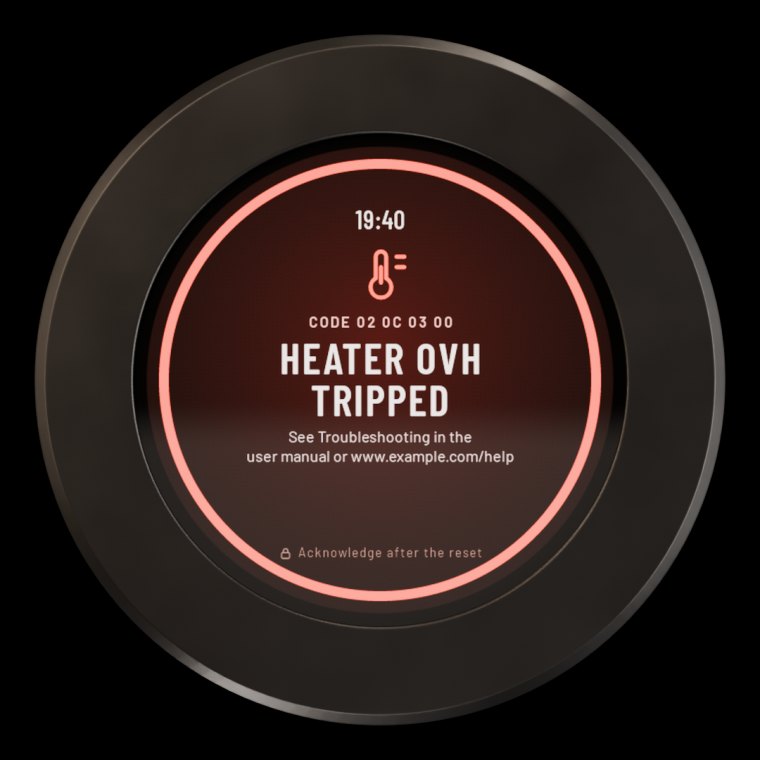
The overheat limiter sits in the wall sensor that comes in the Akmo box, and it switches the heater off by itself. No software is consulted. Only a human hand can reset it.
Door open, no start
The door sensor is wired into the safety circuit that holds the power relays. With the door open there is nothing for a stray tap or a phone to switch on.
Four hours, then dark
A timer made of plain logic chips cuts the heat four hours after it was switched on, at the latest. Software can end a visit sooner, but cannot stretch one past it.
It doubts itself
Every time it is switched on, and before every remote start, the controller proves its relays can still switch off; at every stop it checks that they did. As each session first heats, it measures the heater's current. A stuck relay or a dead element means no heat, and the screen says so.
A dead man's handle
The controller's processor must keep proving it is alive. Within half a second of it stopping, the heater drops out.
Nothing live to touch
The panel and its cable carry 24 V. Akmo's mains parts live inside earthed steel, kept at least 8 mm from the low voltage on the power board.
When something is not right
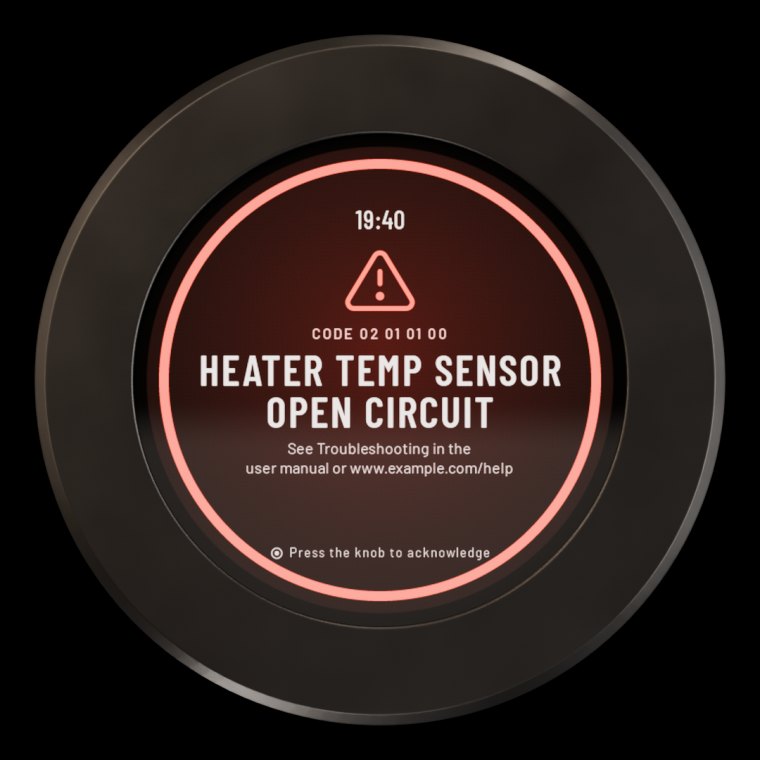
It stops, and it tells you why.
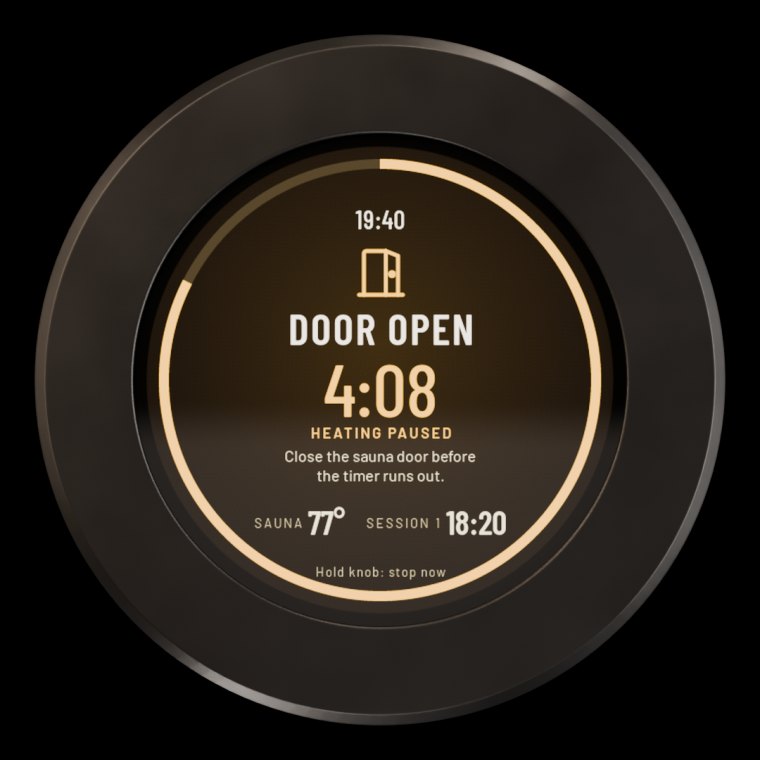
No blinking light to decode. The dial says what happened, in words, and what to do next.
Remote start
Walk into a hot sauna. Not into a surprise.
Have it hot when you get there. Once you have armed it at the dial, Akmo can be started remotely, unless someone has opened the door since or a fault has been found.
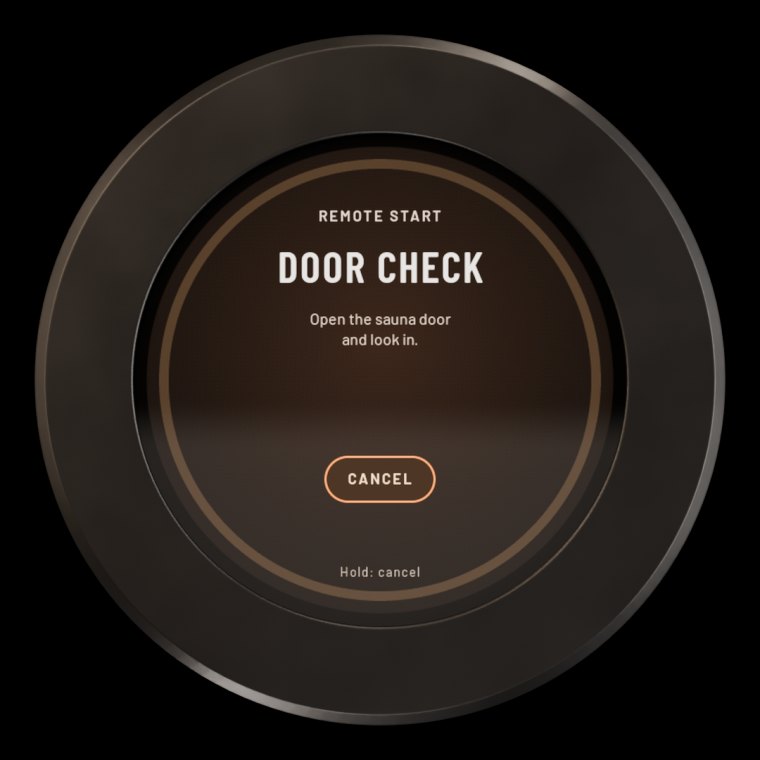
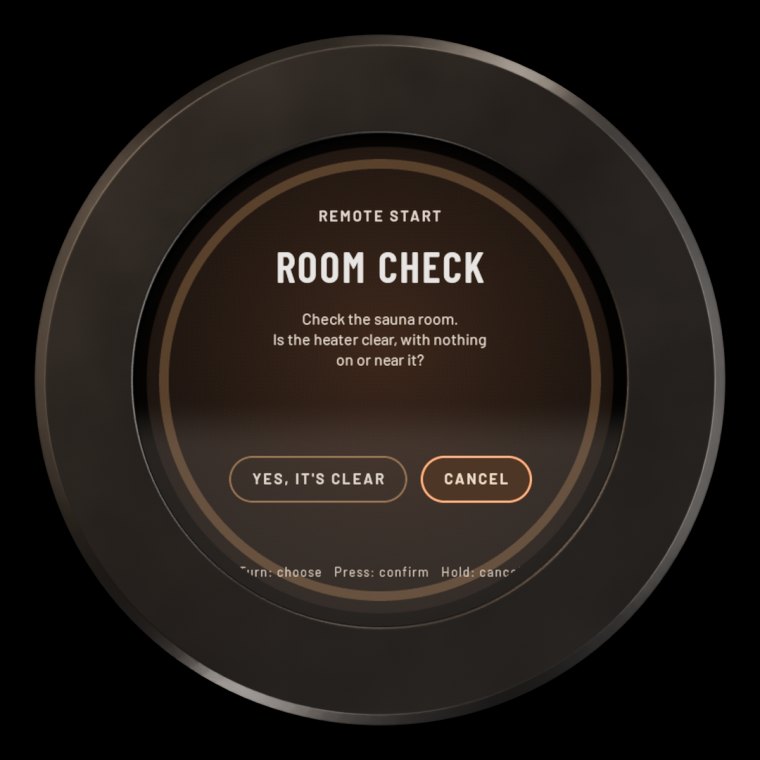
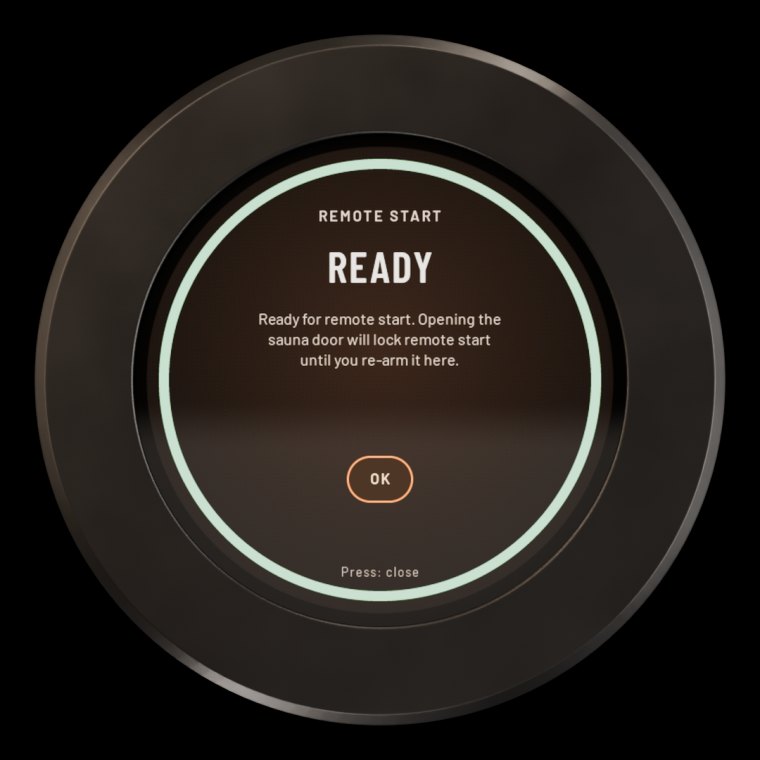
Half a minute at the door
- Tap Remote at the top of the panel.
- Open the door, look in, and close it. The controller has to see the door open and shut.
- Confirm that the room is clear.
- Akmo checks its system for a few seconds, then remote start is ready.
And it stays honest
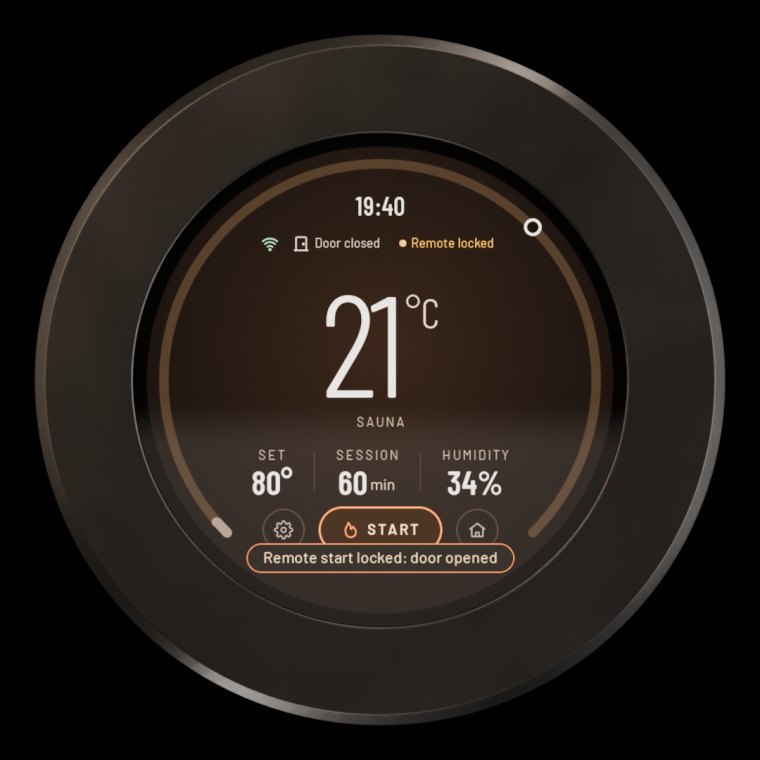
- Open the door afterwards, and permission is gone.
- Sauna switched off, and permission is gone.
- Any fault or lost link, and permission is gone.
No app can grant it, and there is no setting to switch the check off.
Standards
Designed to the sauna standard. Testing to follow.
Akmo is designed to the requirements of EN 60335-2-53 for sauna heater controls and EN 60335-1 for household appliance safety, with reinforced insulation to IEC 60664-1. Independent testing and certification are still to come.
What is in the design today
- A 4-hour hardware cut-off. The standard allows a household sauna 6 hours. Akmo's software ends a visit at 3 h 50, and a hardware cut-off at 4 hours needs no help from the processor.
- Reinforced insulation between mains and low voltage: at least 8 mm of creepage on the power board.
- Two relays in series on each of the three heating elements, each rated 16 A.
- A self-test at switch-on and before any remote start: each safety relay is dropped alone and checked. At the first heat-up of a session the heater's total current is measured, to show all three elements are drawing.
- 24 V at the panel, from a certified power supply.
- Every single fault in the safety chain modelled and traced: what it does, and how the self-test finds it.
What we do not claim yet
- No test house has examined Akmo, so it carries no CE or UKCA mark.
- Electrical safety, EMC and radio testing are all still to come.
- We will publish the results here, good or bad.
Be first
Be one of the first to turn it.
The first batch will be small, and the people on this list get it first, at the launch price. Until then: one honest email a fortnight from the workbench.